
This post may contain affiliate links. Please see our disclosure policy.

Why is acute medication for vestibular migraine important? Vestibular migraine can produce daily dizziness, but also can occur with episodic, disabling attacks of vertigo, head pressure, and sometimes pain.
This fluctuation in symptoms can be stabilized by using preventative medications, which work to prevent attacks before they happen. But as people living with migraine know, occasionally some attacks slip through and we’re left scrambling to get rid of them as quickly as they came on. This is where acute vestibular migraine treatments come in.
When used either at the first sign of symptoms or in the midst of a full blown attack, these acute vestibular migraine treatments can either help to completely stop the symptoms or lessen the severity of the attack.
For typical migraine attacks that involve head pain, these are usually analgesics like naproxen (Aleve), ibuprofen, acetaminophen, triptans and gepants (migraine specific pain meds), and ergotamines. But what do you take if you don’t get head pain with your migraine attacks? Don’t worry, you have options!
This post is not medical advice, and only meant to give information and share my own personal experience. Please discuss all treatments with your physician.
Table of Contents
- Vestibular Migraine Attack Symptoms
- Triptans for Vestibular Migraine
- Antihistamines for Migraine
- Benzodiazepines for Vertigo
- Timolol Eye Drops
- Menstrual Migraine Options
- Neuromodulation Devices for Vestibular Migraine
- gammaCore for Vestibular Migraine
- Truvaga
- Cefaly for Vestibular Migraine
- Vertigo Prevention
- New Medications for Vestibular Migraine
- Vestibular Migraine Treatment at Home
Vestibular Migraine Attack Symptoms
Very little has been studied on the effect of these with vestibular migraine. Those who live with VM know that not every attack involves a headache or head pain. In fact, up to 50% of people can have vestibular migraine attacks without any headache present. So what kind of symptoms are experienced during a bad vestibular migraine attack?
These can include (but are not limited to):
- Vertigo, which is usually defined as a spinning sensation in clinics, where either you feel as though you are spinning, or the world around you is.
- Continuous dizziness that feels like a foggy brain or lightheadedness, like you’re about to pass out.
- Drop attacks – feeling as though you are falling
- False sense of movement – not limited to drop attacks or vertigo, this can be moving from side to side, intense rocking, or like you’re floating
- Alice in Wonderland Syndrome – where objects or body parts appear smaller or larger than what they are.
- Visual distortions and visual snow
- Derealization and depersonalization – a disconnect the environment around you or from your body
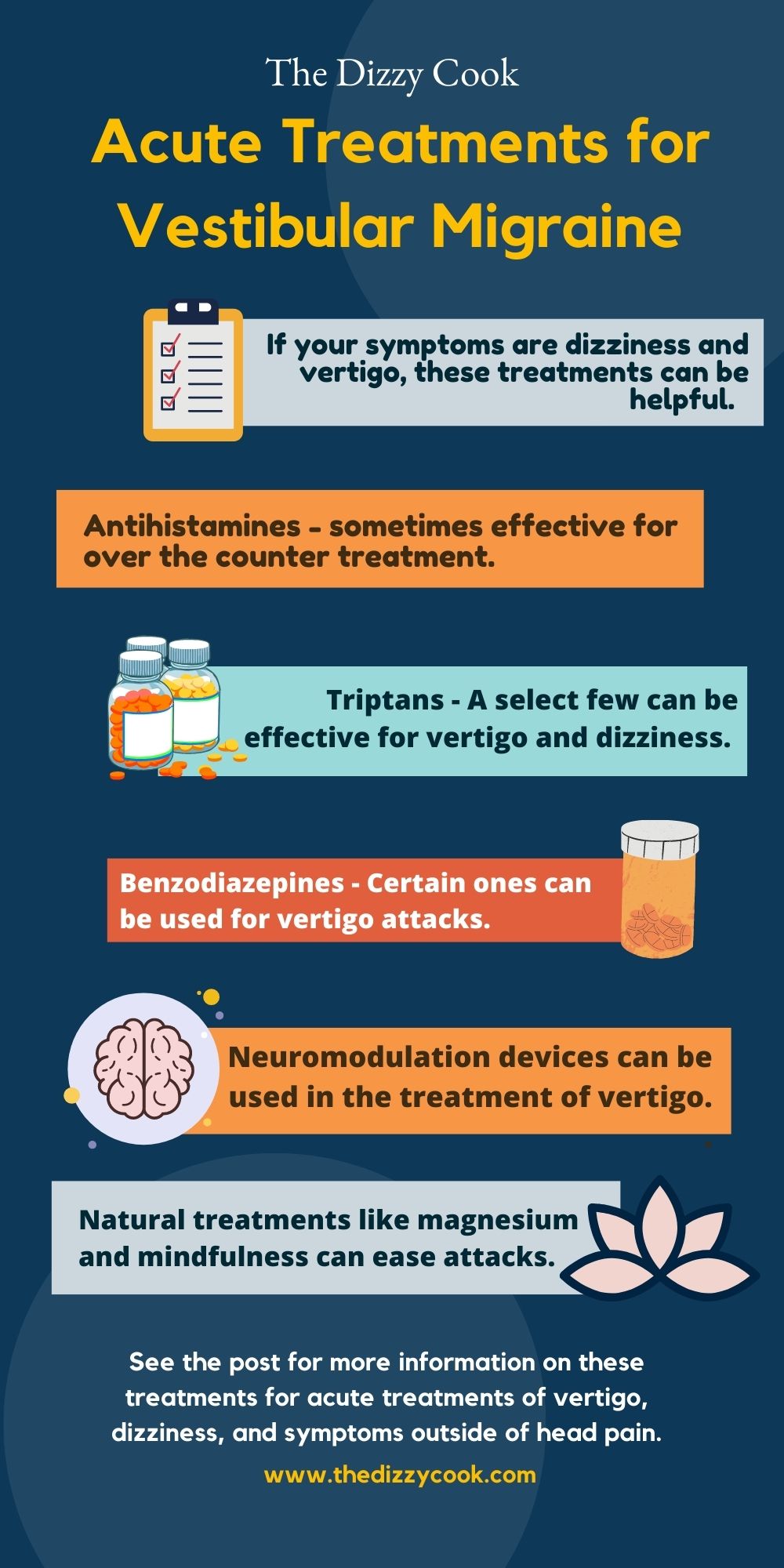
If none of these sensations cause pain, but are just are terrifying and debilitating in their own way, how do we stop them? Here are a few new and existing vestibular migraine treatments that can be used acutely.
Triptans for Vestibular Migraine
Triptans have been controversial when it comes to vestibular migraine, especially when head pain is not involved. Some older, small studies showed some support for triptans, including rizatriptan and zolmitriptan.
However, newer research is showing that triptans appear to be more helpful for patients with head pain rather than vertigo and dizziness. A large 2025 study with rizatriptan showed it was ineffective for managing acute vestibular migraine symptoms and did not reduce vertigo. It is the newest recommendation that triptans are not the most effective acute treatment when it comes to vestibular migraine related vertigo.
I’ve discussed this before with Dr. Shin Beh, and this is also what he finds in his own clinic. Generally he reserves triptan use for those who have pain with their vestibular migraine attacks.

Antihistamines for Migraine
Medically these are referred to as meclizine, dimenhydrinate, and diphenhydramine. You may know these are Antivert, Dramamine, and Benadryl because as mixed antihistamine/anticholinergics they are commonly the go-to for doctors to prescribe when patients mention vertigo episodes. These are vestibular suppressants, not meant to be used for prevention, but can be used acutely and are found over-the-counter making them easy to access without a prescription.
These are always kind of glazed over when talking about vestibular migraine, especially in studies. It seems because they are widely known and tend to help with motion sickness, they’re often recommended.
Two acute treatments you may not know – hydroxyzine and cyproheptadine. These can provide relief from pain as well as potentially help anxiety symptoms.
Cyproheptadine is a histamine and serotonin antagonist and has been successfully used at preventing migraine in children. It is also used for pediatric vertigo.
Because antihistamines are sedating and can help lower anxiety, some physicians like to use them instead of benzodiazepines as they don’t have the same level of risk of addiction.
However, antihistamines for vestibular migraine may not be the most effective treatment you can find. I personally see these as an easy place to start, but don’t be discouraged if you don’t see a huge benefit for stopping a severe vestibular migraine attack. The other commonly reported side effect is they can be sedating and cause weight gain.
My personal experience with hydroxyzine and cyproheptadine were that they helped with mild attacks and I slept very well, but the next day I was groggy and extremely hungry. After a few days of taking hydroxyzine, I found I would consume a lot more food than usual. I find they are a good alternative for my rare, mild attacks. For me, they did not replace the effectiveness of lorazepam.
Benzodiazepines for Vertigo
Benzos like Ativan (Lorazepam), Valium (Diazepam), and Klonopin (Clonazepam) can be used in the lowest dosages for acute treatment vestibular migraine attacks. In my interview with Dr. Beh, we discussed how these aren’t always the first protocol for attacks, but they can be effective for people who aren’t helped by other methods like antihistamines or non-pharmacological treatments.
Dr. Beh mentioned these tend to be useful for patients who also experience increased anxiety with their attacks, and I also find this to be true in the community.
Dr. Timothy Hain shares a stepped vertigo protocol where he begins with Meclizine before transitioning into certain benzodiazepines. He states certain benzos tend to be less sedating but have an increase in dependency. Some are not prescribed due to their high risk of dependency, such as Xanax (alprazolam).
As discussed in this post on managing migrainous vertigo attacks, the use for these can be controversial due to addiction risk. This is something Dr. Hain has visited previously on his site, in which he says the risk can be decreased by staying with the lowest possible doses and taking as prescribed. Compensation should not be a concern on these low doses.
For me, lorazepam for vertigo attacks was extremely effective and still is to this day. These days I just take as needed for dizziness, but when I was ready to wean off migraine medication, I had no issue at the low dose I was taking. You can review my treatment plan with all the details.
Timolol Eye Drops
Something I talk about often as it was part of my own vestibular migraine treatments, is Timolol Eye Drops. Most commonly used for glaucoma patients, these eye drops are basically a lower dosage of beta blockers, which have shown success for migraine prevention.
The interesting twist is that because these can be administered through the eyes or as a nasal spray, the medication is absorbed much faster into the blood stream than taking an actual pill.
Again, a small study showed success with using these as an acute treatment for migraine with head pain. I cannot say for sure if this is just something that I tested in Dr. Beh’s clinic, or if this is a more widely used treatment for vestibular migraine, but it does work for me and quite a few vestibular migraine friends.
No studies have shown the success with this medication and vestibular migraine specifically.
Menstrual Migraine Options
If you’re someone who has an increase in symptoms around your period, this may be helpful.
Vitamin E proved to be effective for menstrual migraine in reducing the frequency and severity of attacks. 400IU daily for 5 days is recommending, beginning 2-3 days before your cycle through the beginning of it.
Acetazolamide (Diamox) is generally prescribed for altitude sickness, but has been studied in the prevention of vestibular migraine. Out of 50 patients, the majority experienced relief from vertigo and headache frequency, with a big emphasis on it being most effective for vertigo.
For menstrual migraine, 500mg daily, starting 2-3 days before the predicted menstrual cycle for 5 total days resulted in a significant improvement. The biggest relief was reported with symptoms of nausea, dizziness, pain, and light and sound sensitivity.
A previous study had showed acetazolamide may not be well tolerated for daily treatment, and it seems to work better as an acute treatment. Potential uses could be for menstrual migraine, air travel or high altitude travel. I also wonder if it could be helpful for barometric pressure induced attacks.
Neuromodulation Devices for Vestibular Migraine
One exciting and recent study, published by Dr. Shin Beh and Dr. Deborah Friedman, reviewed the benefits of nVNS (which stands for noninvasive vagus nerve stimulation) as an acute treatment for vestibular migraine.
Your vagus nerve basically connects your gut to your brain. So naturally it makes sense that with a type of migraine that can affect our gut so much, this could be helpful for anxiety, stress, and nausea.
The study tested 18 patients, 14 with a VM attack, and found that vertigo was reduced in 13 or the 14 patients. 4 patients with PPPD were also tested and found no improvement.
gammaCore for Vestibular Migraine
This nVNS device is also known as gammaCore and can be used at home. It is available as both a preventative and acute treatment. It used to cost $600 a month, but the pricing has been reduced to make it more affordable. If your doctor is a part of a hospital research program, the cost is $150 a month for 3 months of treatment, or you can get a similar discount with my code.
I’ve always wanted to try this device and it worked out to test it during my postpartum phase when I was struggling with more vestibular migraine attacks due to lack of sleep. I found it to not only be helpful to reduce dizziness, nausea, and head pain (something new for me after IVF and pregnancy with migraine), but also to help bring down my anxiety. The best part was that I could use it as an acute treatment without it compromising my mental clarity or driving ability, like many medications do.
Each stimulation is 2 minutes and feels like a gentle buzz. Each session is usually 2 stimulations on the same side for a total of 4 minutes. With gammaCore you rent the device for 3 months at a time.
I share my journey with using gammaCore as a migraine treatment, so don’t miss out if you’re interested. Use my code dizzycook for 15% off your gammaCore device.
Truvaga
Truvaga is another nVNS, vagus nerve stimulation, device that is not approved for the treatment of migraine like gammaCore. However, it can help with some of the health issues we need help with like better sleep, less stress, and clearer thinking. The devices are very similar in how they work.
With Truvaga, you can buy the 350, which has 350 preloaded sessions on it, or the unlimited. I’ve used both and love that I can use the unlimited whenever I need to, as well as everyday, but dislike that it has to be connected to my phone. Use my code AFFILIATE10 for a discount.
Cefaly for Vestibular Migraine
Another neuromodulation device that’s being used within my clinic is the Cefaly. This device stimulates the trigeminal nerve instead of the vagus nerve, so it’s placed on the forehead rather than the neck. Typically this stimulation is beneficial for those with any kind of head pain or sinus pressure.
Cefaly comes with two settings, an acute and preventative setting. The total cost is $499, and then you purchase the electrodes which have about 10-20 uses. You can also purchase the devices separately (for preventative and acute treatment) for a discount if you only want to use it for one or the other. Once purchased, you own the device.
Sessions are comprised with 20 and 60 minute sessions, but since the device is placed on your forehead, it can be tricky to move around. I like to use this while meditating or laying down for a break.
Cefaly has recently been studied for vestibular migraine attacks, but I initially felt it provoked my dizziness. With their new Cece app, you can better control the intensity of the stimulations. I prefer to keep mine on a lower setting, and it helps immensely with any pain or head pressure days.
I find Cefaly to be the most effective for pain and head pressure out of all the devices, so I highly recommend it, especially if you have one sided pain. They give you a 60 day trial period to see if you like it. Get 15% off Cefaly with code dizzycook.
Vertigo Prevention
Duloxetine (Cymbalta) may be a potential preventative treatment for vestibular migraine. In a study it significantly reduced vertigo severity, number of vertigo attacks, and overall dizziness for patients.
Venlafaxine (Effexor) is what I see more commonly prescribed and also has some evidence showing it is helpful for vertigo. These types of medications are daily preventative options and not meant to be taken short term for acute relief like the options above.
New Medications for Vestibular Migraine
I have not personally tried any of the newer gepants for vestibular migraine, but they are becoming popular. These work by inhibiting CGRP, which is responsible for head pain signaling in the brain. Generally relief is felt within 2 hours.
Nurtec (rimegepant) is a tablet that has been approved for both the acute treatment and preventative treatment of migraine. Studies have shown it’s been helpful for light sensitivity, sound sensitivity and nausea, which can be common with vestibular migraine attacks. At this time, there is no evidence on Nurtec for migraine related vertigo specifically.
Although Ubrelvy and Reyvow fall into the same category, Nurtec seems to be the most popularly prescribed for vestibular migraine specifically.
Emgality (galcanezumab) shows some promise when it comes to vestibular migraine prevention. Participants experienced fewer dizzy days and less dizziness related disability. The drawback is that Emgality, Ajovy, and Aimovig are once a month injections, meant to be a migraine preventative and not an effective acute treatment. Sometimes it can take 6 months or more to even see results.
Botox was also found to be helpful for dizziness and migraine, and I do see this with followers as well. However, it can be expensive and also take a few months to work. This is also a preventative treatment and less helpful in acute situations.

Vestibular Migraine Treatment at Home
Some acute vestibular migraine treatments at home that you may already have on hand include:
- Extra magnesium
- Avulux glasses
- Topical magnesium – lotion or foot soaks. Some people find soaking their feet in warm water to be helpful at relieving an attack. I think this is harder with vertigo and prefer lotion.
- Cognitive Behavioral Therapy, Tapping, or Visualization
- Motion sickness bands
- Increase hydration
- Decreasing stress
I know the last one is really difficult – everyone tells us to do this, but it is easier said than done. But truly this can look different for every individual.
For me, I had to make a really tough decision to leave my old job as all my other stress relief tactics weren’t enough. You know it’s probably an issue when your neurologist, nurse practitioner, family, husband, and therapist are all telling you to quit your job.
I also added in massage therapy every two weeks as a scheduled appointment. Financially, it’s expensive, but my mental health (and neck) benefitted a ton from this investment. I started viewing it as another migraine treatment instead of a luxury, especially since it’s just as helpful as some of my medications.
Overall, I believe we know what works best for us, it’s just sometimes doing it that’s the difficult part. I hope this post gives you some great ideas to discuss with your physician regarding acute vestibular migraine and vertigo treatments.





I thought I would share what has helped me, since it seems many of us need to lead our doctors with ideas. I definitely had daily dizziness for months before i was diagnosed. The medication that broke the cycle was Verapamil. I take the 240 ER version. That got me to having some clear days, but I was still having frequent episodes. I tried Trokendi but didn’t find it helpful. We added in Botox every 11weeks a couple of years ago. At first, I didn’t think it was helping, but after the first three treatments, I noticed fewer episodes happening and now, I notice that the last week or two before I’m due are my worst for symptoms. I’m also using Aimovig. Once a month. I find the thought of using benzodiazepines a little scary. I also have fibromyalgia and was prescribed clonopin at its lowest dose nightly for sleep. I usually only took half a pill. But used it for a few years. When I went through vestibular testing, I had to not take it and was told that it was a dangerous medication. As I attempted to stop taking it, I realized that my brain had become dependent on it and I couldn’t sleep at all without it . It took a couple of months to slowly wean off of it. Do Not try to go cold turkey stopping that medication as I had a coworker who had to be hospitalized from trying that and going too long without sleeping. For me, sometimes taking 4 ibuprofen can avert, or lessen an episode. I’ve tried Maxalt and while it helps with my more typical pain based migraines, it hasn’t helped with my vestibular episodes. I’d love to try the timolo , but my doctor wasn’t familiar with the treatment and seemed reluctant to explore it.
I think as you point out, the length of time you take benzos and the amount is important to avoid becoming dependent. Even certain types are not to be prescribed to avoid addiction. Most people who do take benzos for years like yourself have to wean off very slowly over the course of weeks – that should have been made very clear to you and your friend. For VM, it’s not recommended for more than a few months of daily use. I was on the lowest dose of ativan for about 6 months and my neuro even had me cutting my pill into slivers over the course of a month of guided weaning. I had no issues coming off of it. I don’t like to promote fear of these meds as they have helped me and several of my VM friends immensely. The key is just managing it carefully under a good physician.
I too made the difficult decision to leave my stressful job, but it worked. I haven’t had any issues since. I was miserable with the symptoms of the vestibular migraines. Mostly the vertigo and the feeling of being disconnected from my body. It was such a odd sensation. I hated the symptoms. I hated the testing to get the diagnosis. I was bound to try to solve it by natural remedies. I take magenesium and have actively tried to de stress. So far its’working! Fingers crossed
Alicia, I just came across your blog and it’s so helpful to hear someone with almost the same story. I have spent countless hours researching myself. My neurologist was puzzled because daily dizziness was not something they see with VM. The ENT said it was normal. I was started on Trokendi and the dose is pretty high at 100mg so he wants to wean it down now that I’m under better control. I still have bad days but Atleast it’s not 24/7. I’ve tried about every rescue med there is and NSAIDS with caffeine are what work for me. I start by second round of Botox this week and the hope is that after the second or 3rd dose symptoms improve and they hope to get me off the Trokendi. Side effects of the meds are not great with leg tingling, word finding difficulty and brain fog (which can be hard to distinguish from the migraine). I do not like taking meds so I’m looking for other options like supplements and diet. I was taking migratone which doesn’t seem to be enough magnesium after listening to your podcast and reading this. And vitamin B12 (Wrong B it sounds like) so I so appreciate all the information you’ve gathered to help others. I wish I came across it sooner but glad I came across it because I feel like I’m sliding backwards not forwards. I have celiac and have to follow a GF and FODMAP diet so I’m already very limited. Some of my biggest concerns are now taking out nuts because they are some of the only ways i was able to get protein. I can’t have beans anyway so that was not an issue. But nuts and almond flour which is a staple for GF is a concern. Is there anything that says for GF patients almonds are ok?
Also… I forgot to ask you, how do you take your magnesium ? How much of each and when do you take each?
Hey Jennifer – you may find this post helpful, it answers your questions about my supplements.
As for taking out nuts, I think you’ll find seeds are a great replacement. Sunflower seeds, pumpkin seeds, chia seeds, sacha inchi seeds, hemp seeds…so many choices! And there are some fantastic seed butters on the market now too, especially with 88 Acres. Also remember there are many good sources of protein through lean meats and fish plus lots of veggies. Cassava flour is a great sub for almond flour sometimes, pumpkin seed flour (which I make) is also good too. But I think you’ll find a lot of good gluten free recipes on this site. You may just have to leave out garlic here and there. A lot of my IBS issues improved more with this diet than low FODMAP actually.
Hi…has anyone been recommended Botox injections for their VM? My neurologist has recommended that I get the injections after trying Candesartan, B2, magnesium 500, and still have constant dizziness since March 2020… so grateful for any input..thank you, Denise
Denise, my neurologist recommends it usually if you’ve failed 2 other migraine medications (for insurance purposes mostly). It’s worth a try if you are interested in it. It does take a few treatments to work and has to be kept up with every few months.
Thank you so much for getting back to me..I’m very grateful…this feels like I’m alone in this and evidently I’m not…
I guess I will try the injections…
And I want to try your diet!!
Thanks so much!
xx Denise
I noticed relief when I had Botox prior to it being approved as a migraine treatment. So glad I was able to continue, now that it is covered by insurance.I still take magnesium (threonate in the am, glycinate in the pm), as well as B2, feverfew, and CBD. I find CBD will stop a migraine attack in the aura stage if I take a quickly bioavailable form like gummies right away. I always keep a Valium on my person to take to abort a vertigo attack at first sign. I also find that diet is very important, as I have food triggers. I basically follow a keto/FODMAP diet. Alicia’s recipes are great for that, or I only eat whole, unseasoned food, no gluten.
Take magnesium in the evening because it helps to relax and sleep better.
Thank you. My neurologist here only gives rebound drugs, so I experiment a little. Bought Pure Formulas Magnesium and am only taking for now one additional pill to my CogniMag. It would take 7 pills totak to get to John Hopkins recommended dosage. I have also started taking 1 Lemon Bioflavonoid daily for ears.Since we have started conversing I have started having some good days. Just into 4th month on your diet recipes. Have started using your clean recommendations and mix and match to make new meals. Love your recipes. My husband eats clean with me too. I’ve even started using my treadmill again, ringing ears and all.. I believe there is a light at the end of the tunnel, just don’t know how much I want to experiment with triggers. I like feeling better more. Being isolated with my hubby of almost 48 years is easy. I used your recipe for bar-b-que ranch dressing for a marinade on chicken to make kabobs. So great.I do even more than that with your recipes. I appreciate you very much. Keeo me in loop for Dr. Buchholz in Sept. Sincerely, Carolyn
Just one other thing. For the life of me I can’t find a clean bun for sandwiches. There aren’t really bakeries here in Vegas I know of that make clean ones. Can you recommend a safe brand from somewhere here I can eat. Thanks again for your wonderful connection. Your communications are really special and make me feel truly connected to someone who understands all I been going through Thanks again..
Hi. Just wanted to let you know that I tried my first dose of Melatonin last night and won’t be taking again. I felt a little loopy before bed even though separated by a couple hours from my nightly Clonozepam. Then when I woke up during night to use restroom I was so drunk like I could hardly walk. Felt very off in morning. I am very sensitive to meds and this one really reacted poorly for me. I will be fine however and will work this out some other way. Carolyn
Hey Carolyn, sorry you had that reaction. Melatonin is usually taken to aid you in sleeping so I would imagine that’s why you were a little loopy. It’s supposed to make you tired. I’m sure mixed with a benzo it was a lot! A lot of the questions you sent me are best asked with a neurologist. I’m not a doctor so I really can’t advise you on personal dosages, just give you recommendations to bring to your physician. 🙂
Hey Alicia! My neuro prescribed me Zumatriptan (Imitrex) for my really bad VM attacks. Have you heard of other VM’ers with success using this medicine? I haven’t used it yet as Naproxen and Benedryl are my first step defense for attacks. I would love to know if you have heard anything about this one. Thanks!
Hey Ryanne, there is one study a while ago that showed sumatriptan could be helpful, so it’s always worth a try. I don’t see people discuss it often though.
I have VM and have been using sumatriptans as a rescue medication and no joke it knocks it out within a hour. You will feel sluggish the rest of the day but the dizzy and vertigo and onset of attacks are gone. I’m currently taking Clonazepam daily at night for preventative and it helps with the floating and dizzying swirly feels. I’m still working on what to do and take for when triggers like storms or my work on the computer I need like an extra “boost”—my neuro wants me to try a new drug ubrevly but it’s way too expensive $3,000.00 no joke! So currently working to get help with the meds to see if it will be helpful.
What dose of sumatriptan do you use? My doc gave me 100mg and I haven’t tried it yet and am wondering if that’s too high of a dose
Hi. I am always looking forward to reading your posts but non of them ever address my symptoms. I have a rare headache anymore, sometimes only on days of heightened noise sensitivity. What I have remaining is full body neuropathy and tinnitus, that I have been told is not my ears,as I finally went to House Clinic. in LA. They said the ringing may seem like it’s my ears but it’s coming from somewhere else in my head. I’ve been on the HYH diet religiously for 4 months and seem to be at a standoff. Had to cancel my trip to Maryland to meet and talk to Dr. Buchholz. I take your recommended CoQ10, CogniMag, and have added ckeanB12. Is there something else I can be doing. Just started walking on my treadmill and doing a little project around house that I can tolerate. What am I missing? Hate feeling like little bugs under my skin everywhere and ringing all the time. Thank you for any help you are able to give. Carolyn
Hey Carolyn, I also don’t have headaches but in the beginning I was very sound and light sensitive. You may enjoy this post where many of your symptoms are addressed here but it would be impossible to list out all the strange symptoms that come along with VM…well, maybe not impossible, but a very long list! I know Lemon bioflavonoids are helpful for tinnitus. Here are some other good tips.
Do you take any other magnesium besides cognimag? Cognimag is a very low dosage and Johns Hopkins recommends a dosage between 600-800mg for migraine. So that could be something you add in a less expensive version like magnesium glycinate. Hope you can maybe get a teleconference appointment soon with a neurologist.
Hi there! I just recently came across your blog and was so excited to find someone that’s gone through what seems to be the same as me and has come out on the other side. I’ve been dealing with what I thought was just vertigo for many years now (about 7+) and in the past it would just happen every couple of months or so. But for the last maybe 3-4 years I can tell it’s gotten worse and for the last 2 years I’ve been working from home (I quit my old job because I was getting so dizzy at work it was affecting me horribly). And I want to say for the last year I feel like I’m dealing with it on a daily basis, which makes me very depressed and like I’m going crazy or something’s wrong with me lol. Every day I feel “off-balance” I guess you could say and my head feels weird maybe floaty when I’m walking around outside or even when I’m just sitting but turn my head to look at something. I’ve done so much research online and went to a neurologist a week ago who has me trying out nortriptyline (20mg) and magnesium supplements but he seemed to think that vestibular migraines happened more so with light and sound sensitivity and would happen in episodes/attacks. But mine is a daily dizziness and I’m not light or noise sensitive that I can tell but I know that busy patterns(like a rug or flooring), or going to the grocery store, or looking at traffic while driving, and fluorescent lights all seem to make it worse. Did you ever experience daily dizziness or am I dealing with something different here? Sorry for the long post lol, I just feel so helpless :/
Didn’t know if you missed my comment? To sum up just wanted to know if daily dizziness is common with VM (my neuro didn’t seem to think so), and if the triggers I mentioned match up with VM? Thanks!
Hey Danielle,
So sorry I missed you! So you do have a lot of symptoms that I actually had with VM…and did you notice that you said fluorescent lights make it worse? That’s considered light sensitivity too!! Noise sensitivity, like if you notice that you have trouble focusing on one sound or have trouble in restaurants (although not really an issue now), it can be as small as that. You can be dizzy every day with VM, but if it’s changing in severity (like maybe sometimes you have the floaty feeling and then other days you have more severe symptoms like vertigo or maybe the floating is so extreme it’s hard to walk) that’s VM.
If the dizziness is constant at the same level there’s another vestibular disorder called PPPD and this can also be comorbid with VM or it can exist on its own. If you’d like to learn a little bit more about the differences, I highly recommend watching this video with my neurologist “The Dizzy Doctor” where he will tell how it’s distinguished. I hope that’s helpful!
Thank you! And I watched the video you linked. Very helpful. I do have a couple questions if you don’t mind? So my neurologist had me try nortriptyline but I found that it actually made my dizziness worse and I read that that can actually be one of the side effects (and I was on it for 3 weeks and it didn’t go away). Unfortunately I am very sensitive to those types of meds it seems, so I got off that. I just had an appointment with a Balance & Ear doctor who said it def sounds like I have VM which he’s familiar with. And he prescribed me Clonazepam .25 mg once a day at night before bed. He wants me to take them for a month and then come back and try a couple other tests. Do you know anyone who takes Clonazepam for VM and I know you mentioned you started with Ativan….do you know why doctors prescribe Benzos for VM, how does it help? And how long were you on yours for? I just don’t want to get addicted to/dependent on them and I’m just wondering what else I should be doing besides taking a Benzo and supplements like magnesium etc or is that enough to fix it? Lastly, did you take the Timolol eye drops while you were taking Ativan? Is it safe to take both, and did you notice any side effects when taking the eye drops?
I can tell you I have slot of the same. My neuro was the same way. He said daily dizziness wasn’t normal with VM… it was more episodic. The ENT said daily dizziness can happen . I researched and read and others say yes it’s daily. Everyone is different. Now with meds it’s not all the time. But floaty head yes. Mostly when walking first in the morning. People think you’re crazy because you describe it and it’s only at certain times. Rugs drive me crazy. Lights are definitely a trigger for me. Migraine glasses and time help. I had to keep exposing myself to the rugs more and more to get used to them. The lights just bother me a lot. Not much other than the glasses help. I do not get headaches. I’m just dizzy and floaty .
Hey Jennifer – same here. I was dizzy and floaty for a long time but it eventually improved with diet, supplements, meds, hydration, sleep schedule, therapy…etc. If you’re very visually triggered, you may want to look into vestibular therapy! It helped me a lot with stuff like crazy rugs.
Yea I totally feel you on the rugs, dizziness and floaty feeling. I feel that when I’m sitting down it doesn’t bother me as much unless I turn my head a certain way sometimes, but when I get up and start walking around that’s when I really notice it, which stinks because I’m not trying to sit/lay down for the rest of my life lol. When you said migraine glasses are you referring to the tinted ones that Alicia talks about or ones with prisms?