
This post may contain affiliate links. Please see our disclosure policy.
What are vestibular migraine triggers? Basically they’re occurrences that either heighten existing symptoms, like going from background dizziness to vertigo, or start symptoms when you were previously feeling good.
My Journey with Vestibular Migraine
When my symptoms were 24/7, just 4 years ago, it seemed like everything was a vestibular migraine trigger for me. This time of year truly reminds me of how bad I was just a few years ago. I believe it was this month that I was rushed to the ER with a vertigo attack, convinced I had a brain tumor, only to be sent home with meclizine and a “good luck”.
As I finally received a diagnosis of vestibular migraine (and actually accepted it), I began my path to healing. Throughout this journey I’ve learned so many things, and my treatment plan has also changed over the years. I started off with medications that I’ve since weaned off of. I’ve re-introduced foods I once eliminated on a migraine diet. And my vestibular therapy went from specific exercises in a clinic, to taking HIIT classes and ballet on my own time.
My improvements certainly didn’t happen overnight, and neither did discovering exactly what my triggers were. In fact, some of them took me years to truly figure out and that was only after my brain had a chance to calm down with the combination of medications, diet, and supplements I was doing.
Still, there are a few common vestibular migraine triggers to watch out for that I see often in groups or that happen to me.

Top 10 Vestibular Migraine Triggers
Now these aren’t the only triggers that exist, but they’re some of the more common ones that I have personally experienced.
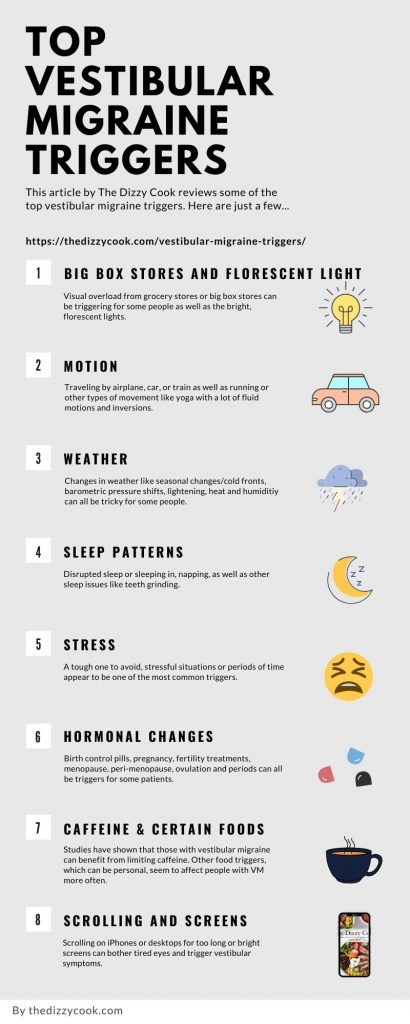
Big Box Stores and Fluorescent Lights
Not only are all the lights bright fluorescent and sometimes flickering (the worst!), but the rows mixed with different patterns of products can leave your vision feeling all kinds of wonky. Not to mention if it’s crowded with other people, it can be difficult to dodge them with your cart while keeping yourself up right.
In the past if someone bumped into me, it would totally throw me off my center of gravity. The one good thing was holding onto the shopping cart, which kept me stable and a little more centered.
Motion
One thing I hated the most was the “sticks” on the HOV lane in Dallas. As I passed by them in the car quickly, they created the most painful visual trigger. Sometimes the sun flickering through trees as we move in the car (or on a path) tends to bother me. Subway or train rides can give me vertigo if I watch the other trains pass in the opposite direction. Long flights or car rides tend to leave me feeling like I’m walking on marshmallows or still moving.
Some people with MDDS (Mal de Debarquement syndrome) actually find they feel better in motion, but most I talk to with vestibular migraine tend to be triggered by it. This could even apply to exercise. Certain exercises, like yoga with a lot of sun salutations, always made me more dizzy and increased the pressure in my head.
Weather
Do you feel as though you can predict the storm patterns if your area better than the weathermen? You’re not alone! Whenever storms are about to roll through, even sometimes a day before, my friend Kayla and I text each other. We can always tell when the weather is about to change. Often it’s worse during storms with lightening, but sometimes it can be from cold fronts or seasonal changes.
Another thing that gets me? Heat and humidity. There was even a study that showed low barometric pressure and higher temperature led to an increase in ER visits for migraine attacks.
Sleep Patterns
Perhaps you’re not sleeping through the night and making up for it by napping during the day. Or maybe you’re sleeping in more and staying up late on weekends to try to switch back during the week. These changes in sleep schedule, although we often don’t think much of them, can trigger attacks for some people.
Even grinding of teeth could be triggering attacks if you are experiencing jaw pain in the mornings.
Stress
In my interview with Dr. Shin Beh, Vestibular Neurologist and founding Director of UT Southwestern’s Vestibular Neurology and Neuro-Visual Disorders Clinic, stress was the number one trigger he saw with his patients. Often many of us can pinpoint the start of our vestibular symptoms to a particularly stressful period in our lives. For me, mine was my former job.
But stress can be a part of everyday life, so it seems to be one of the most difficult vestibular migraine triggers to control.
Hormonal Changes
From using hormonal birth control to spikes around ovulation and before or around our periods, women are prone to hormonal triggers throughout their lifetime. Pregnancy and menopause can either provide a welcomed relief or a spike in symptoms, but every woman is different. Some get relief from using birth control while others are triggered by it.
My neurologist and OB say for pregnancy, there’s a rule of threes. 1/3 of patients improve, 1/3 stay the same, and 1/3 have worsening of symptoms. Much of this can change after delivery. Managing of this particular trigger takes time and a good partnership with your neurologist and OBGYN. If this is a major trigger for you, don’t be afraid to ask your OB to coordinate with your neurologist to find the best treatment path for you. And look into some natural solutions you can try to ease these spikes.
Caffeine & Certain Foods
While caffeine can provide relief for some people with migraine, one study showed that for vestibular migraine specifically, quitting caffeine improved dizziness in 14% of patients as a solo treatment. When combined with nortriptyline, there was a 46% reduction in dizziness.
For me, it continues to be one of my biggest triggers. I can even tell if a coffee is just regular decaf versus a Swiss water processed decaf because I instantly get a fuzzy, floaty feeling in my head. While 14% isn’t a huge number, when you think about it being the only thing these participants changed, I think it’s enough to warrant a try.
While caffeine appears to be one of most common, it seems many with vestibular migraine are more sensitive to dietary triggers and can benefit from elimination diets. For me, a migraine diet and discovering my personal triggers was what pushed me to 100% symptom-free days.
Long Conversations
This is one of the strangest triggers for me, but I find that if I’m holding long, focused conversations, especially when standing, the dizziness seems to creep in. I still can’t figure out if it’s the effort it takes to hold a conversation that is triggering or the focus on someone’s hand motions and moving mouth. Either way, I always found long conversations to spike my vestibular migraine symptoms. Anyone else?
Dehydration
When I was first diagnosed with vestibular migraine, I noticed that being out in warm, humid weather or post workout was when my symptoms would often appear. While it’s easy to blame the workout or the weather, often I think this was due to me not drinking enough water to begin with. Dehydration causes blood volume to decrease, resulting in less blood flow and oxygen to the brain. Some say a loss of electrolytes ignite symptoms as well.
It’s recommended that women drink about 9 cups a day and men 13 cups a day. This translates to about 72-104 ounces a day. I set a goal for myself to drink 4 of my S’well bottle a day back when I had constant symptoms, which is about 100 ounces total a day. With increased water intake, it may be helpful to add in some with electrolytes for every other bottle, like SmartWater (Trader Joe’s has a brand name one that’s less expensive). Or you can just supplement with adding it to your own water with LyteShow.
Scrolling and Screens
Scrolling on my iPhone was something I really struggled with in the beginning, and makes me think perhaps I should be doing more YouTube videos (although I found that movement triggering as well!). I often found myself reading online articles in bits at a time and I rarely went on Facebook or Instagram during that period of time.
A few things that do help are dimming my iPhone and computer screen and wearing migraine glasses, but limiting screen time can go a long way! Save articles you want to read and limit scrolling time as you can.
One thing to note is that some scrolling can be good, especially if you are greatly triggered by it. It’s similar to vestibular therapy, where your brain learns to accept the movement without causing dizziness. But just like vestibular therapy, it’s important to no over-do it.
Need to figure out how to manage these vestibular migraine triggers? Here are some posts that may help.
Vestibular Migraine Guide
Vestibular Migraine and the COVID Vaccine
Vestibular Migraine Prevention Diet
Acute Treatments for Vestibular Migraine
Natural Treatments
Timolol Drops
CBT – Cognitive Behavioral Therapy





Wow, I am nearly in tears and overwhelmed by emotion reading your blog posts. I have been suffering from so many strange symptoms of dizziness, brain fog, feelings of floating, and the strangest being an inability to have long conversations while standing!!! I was convinced that I had psychological issues because during long conversations while standing, I would see the background start to move and feel so unsteady like I needed to hold on to something but if nothing was around to lean on, I would launch into a panic attack with a fight or flight feeling like I needed to run away. I would also experience this feeling while driving sometimes and have to pull over because I would begin hyperventilating. Doctors would just look at me like I was crazy which of course made me believe that I was crazy. To read about your experience and others who have commented experiencing the same issue, I cant believe I am not alone in this. I would like to work with a doctor and hope to find one that knows about vestibular migraine. Thanks so much for your website because without it I may never have know that this could be my problem.
I’m so glad you found me too, Irene. I wish you all the best. It is a scary thing to experience.
These triggers are spot on! I also find that long walks can be a trigger for me, too. The motion of the horizon bobbing up and down with each step + the motion of my surroundings moving past me is a big trigger. Also, if my heart rate is too high for too long (for example, cardiovascular exercise). I tend to stick to slower, weight training movements when it comes to exercise!
Just wanted to say Thankyou for doing what you do. You have basically walked me through this nightmare and I refer to you website many times a day. I can’t wait for your interview with Dr Beh tomorrow. And I just ordered both your books
I actually have a theory about prolonged conversations triggering migraines, because that is one for me as well. While you’re actively speaking and listening, your brain’s activity sky rockets as it receives, process, and creates connections in your thinking allowing you to be able to respond. Just like looking at a bright light for too long is stressful on your processing receptors, information does the same thing.
I’m a very chatty person. My husband usually humors me as I gab away about the day and who did what at work that day, but I found on days when my migraines were worse, I would become almost non verbal. Even a simple sentence would take forever to form in my mind, a huge effort to speak it, and then trying to remember the meaning of words. It’s a little funny, because I’ll say things such as my husband’s favorite, “I has the sleep, now. Goodbye.” It’s really off putting.
My initial bout of vestibular migraines also occurred during a time of very high stress in my life, Now, tube based lighting is a big trigger for me. Any flickering or strobe lighting triggers a feeling of intense panic, I think my brain is warning me to get away before the migraine is triggered. I have cloth filters over the overhead lights in my classroom and usually only turn on half the lights and use lamps around the room.. My biggest trigger though is noise, especially noise in a busy or crowded space where I’m still trying to communicate with others. I’m a teacher and have had to purchase sound reducing ear plugs (Eargasm brand has been the most comfortable for my small ear canals) to survive indoor recess and bus rides for school field trips.
Pretty much all of these And not all the time just depends on my threshold that day.
I’m back at work after 4 months and the scrolling through documents on the screen is sometimes ok but sometimes challenging. I take frequent breaks. But good to know I can train my vestibular system to handle scrolling on the computer!
Wow! I can’t believe you said Long Conversations! I thought I was the only one in the world. It just happened to me Thursday. Standing out in the yard talking to a neighbor can be just brutal after a few minutes. I am so much better than I was through diet and meds. I have many symptoms free days. You just put the last pieces in the puzzle with your list. Thank you!! Do you have any suggestions on how to handle the long conversations without being rude?. I have actually sat down on the grass and that makes the other person feel awkward too.
Oh my gosh, you should not feel awkward or uncomfortable for your chronic illness. If you just say “I’m so sorry, I’m feeling a bit dizzy due to my chronic disorder, do you want to sit with me/mind if I take a break for a few minutes?” I’m sure everyone would be very understanding. Plus it opens a conversation to create awareness among people that may not get it – so you’re being a great advocate at the same time!