
This post may contain affiliate links. Please see our disclosure policy.
You guys know I love effective supplements, so today I wanted to talk about L-Tryptophan for migraine, anxiety and sleep. I have my daily regimen of magnesium glycinate and threonate, Ubiquinol (CoQ10), and a good multivitamin. But being a new mom that went through fertility treatments, an extremely difficult pregnancy, and a traumatic delivery, I found myself crippled with postpartum anxiety and depression.
I should have taken the medication my OBGYN offered me, but instead I decided to try to wait it out with natural treatments, confusing what I was going through with normal baby blues. Sadly I think this is really common for new moms, and it’s only when we’re out of it that we truly see how tough it was.
Please remember this is not a substitute for medical advice and I’m just sharing literature along with what has helped me. Consult with your physician before trying any new supplement.
L-Tryptophan for Migraine
Before I went into labor, I met with my neurologist Dr. Shin Beh to formulate a plan that I could use postpartum if things got bad. Enter a massive vertigo attack during labor, lack of sleep, and visualizing my traumatic labor over and over. That plan went into the garbage with the postpartum anxiety I was trying to overcome. I was trying to eat, but didn’t feel hungry, just nervous. When I finally got a chance to sleep, I couldn’t turn off my brain. My heart felt like it was constantly racing. And I knew this would bring my vestibular migraine back full force if I didn’t get control over it.
Panicked, I emailed him to ask what my options were and how I was trying to manage with my low dose of Ativan that I keep on hand for my emergency acute treatment. That’s when I remembered a page from his book that talked about using tryptophan for migraine.
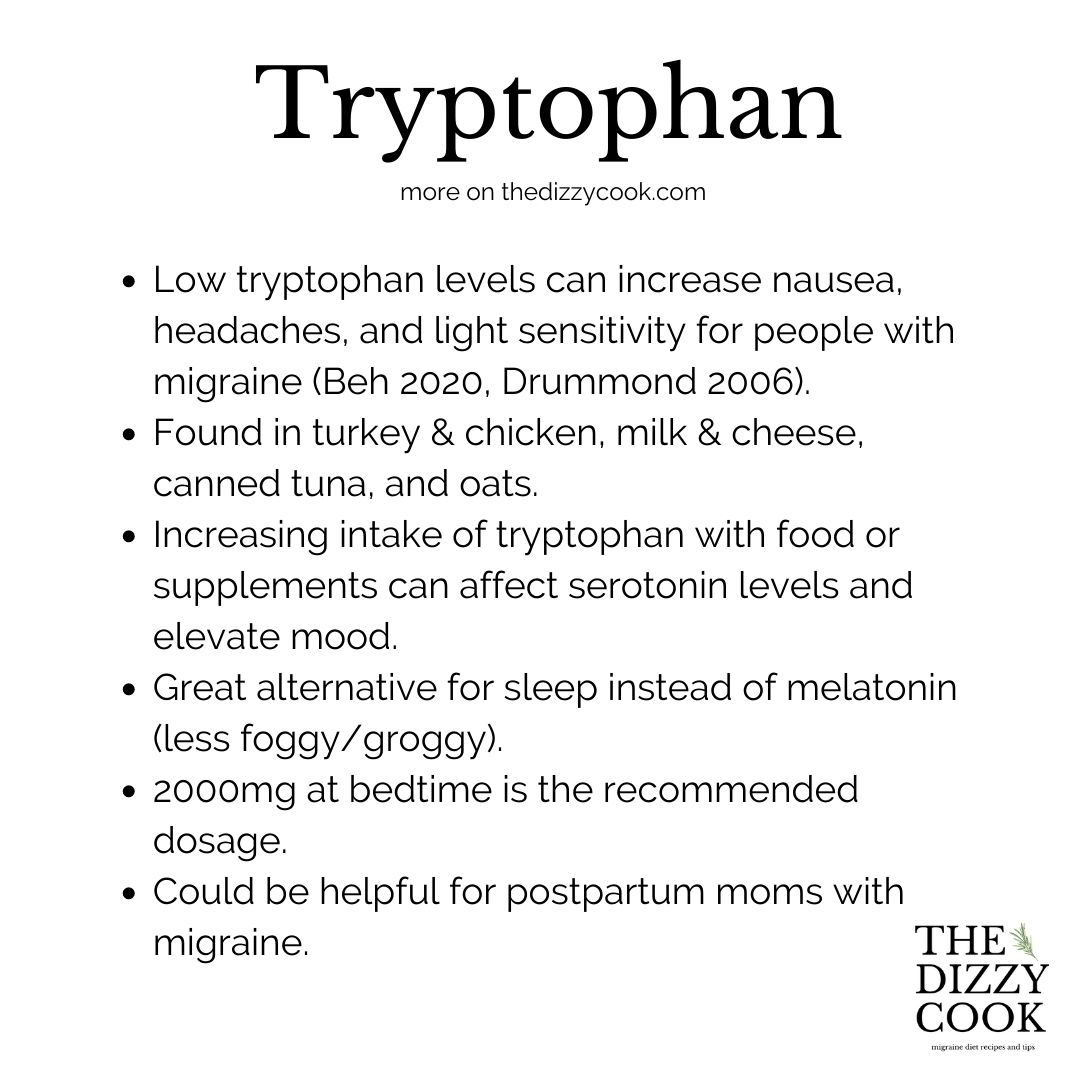
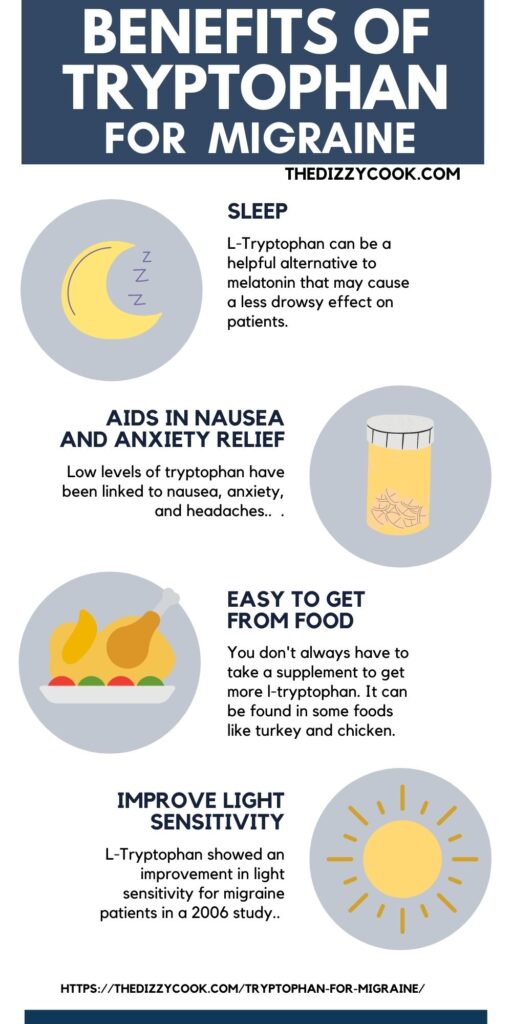
A study by Drummond in 2006 showed that tryptophan depletion in patients caused heightened nausea, light sensitivity, and heightened pain sensitivity as well as motion sickness.
Additionally two studies from the 1970’s show tryptophan raised plasma levels and improved head pain.
Anxiety and Sleep
I figured if my big issue was postpartum anxiety, and this was increasing my chance for vestibular migraine attacks, it would be helpful to try a supplement that’s been shown to help both. Serotonin deficiency plays a part in anxiety and depression, and tryptophan is a precursor for producing serotonin.
A small study from 2014 showed that when patients increased their food intake of tryptophan, it resulted in less depressive symptoms as well as a mood boost and decreased anxiety. It seems like even in the short term, eating foods with higher tryptophan levels can offer a quick mood boost.
A 2016 review of rodents showed that low levels of L-tryptophan increased depression and anxiety symptoms. Another study showed it was helpful for sleep disorders.
In Dr. Beh’s book Victory Over Vestibular Migraine, he mentions that patients tend to prefer L-tryptophan to melatonin as they have less of that hungover feeling when using it for sleep. Melatonin actually gives me very vivid nightmares, so I was happy to have an alternative to aid with sleep.
Foods with L-Tryptophan
Because I needed a little more of a boost, we tried supplementing 2000mg around bedtime. However, there’s another option of just adding more foods with L-Tryptophan to your diet!
I know everyone thinks of turkey as the major source, but there are actually quite a few migraine friendly foods that contain it!
- Canned tuna
- Seeds
- Dairy products like milk and cheese
- Red meat
- Salmon
- Oats
- Eggs
Some recipes you might like to boost tryptophan intake:
Recommended Brands
If you’re looking for supplementation, here are some brands I recommend. Please always check with your physician before using as L-Tryptophan can potentially interfere with certain medications, like SSRI’s and antidepressants.
Personally I take Pure Encapsulations and get it at a great price. What I like about Pure Encapsulations L-Tryptophan is it also contains B6, which can improve nausea as well. So if you find you have that as a part of your vestibular migraine attacks, it’s definitely worth looking into.
Klare Labs is a less expensive option, but contains less per pill.
Although I’ve only been trying it for a few months, I am sleeping better and my anxiety levels have also decreased! Have you ever tried tryptophan for migraine or sleep? Comment below with your experience.







Hi thank you for sharing your experience and your success, you have no idea how much hope my husband has found being that he can relate to you. We have gone to almost every doctor you can imagine, and no one has any answers. I have literally purchased all the supplements, but I am not sure how you used them or how many you used. are you able to list how and when you used them?
Hey Krystal – I have my own story under my treatment plan and then typical dosages for natural treatments.
Hi Alicia! Thank you for sharing this.
May i just ask how long have you been using L-tryptophan? Is it safe to be used long term?
Hey, I only used it for a couple months and once I felt better I stopped. I’d check with your physician on a time period!