
This post may contain affiliate links. Please see our disclosure policy.
If you’ve never been hit by a migrainous vertigo attack before, it’s downright terrifying. Many times patients don’t understand what is happening or why and we immediately start to panic. Often the dizziness or vertigo is so severe, we end up in the ER searching for a way to make it stop. In this post we’ll talk about my favorite ways to relieve vestibular migraine dizziness and stay calm during a vertigo attack.
Diagnostic Criteria for Migrainous Vertigo
Migraine is actually one of the top causes of vertigo, with BPPV being the leading cause, and is often misdiagnosed. This was apparent with a report that referring physicians had a diagnosis rate of suspected Vestibular Migraine at 1.8%. The actual Vestibular Migraine diagnosis rate was 20.2% when the patients were seen in a center specifically for vestibular disorders.
Migraine Associated Vertigo
The IHS considers the term “Migraine Associated Vertigo” to be an old, outdated term for “Vestibular Migraine”. As Dr. Hain explains here, vestibular migraine is considered a subset of MAV. But many clinicians that actually see Vestibular Migraine daily do not necessarily agree with the diagnostic criteria that the IHS puts forward. In his post, Dr. Hain applauds this study from 2015, which looks alternatives to the IHS criteria migraine with vestibular symptoms. New studies have also challenged the idea of the criteria that’s set forth for diagnosis and continue to have the same result….more research on VM is needed.
The Bárány Society says one of the following vestibular symptoms must occur to qualify for a diagnosis of VM:
- spontaneous internal and external spontaneous vertigo
- positional vertigo
- visually induced vertigo
- head motion-induced vertigo
- head motion-induced dizziness with nausea
Spontaneous vertigo is one of the most common symptoms in patients diagnosed with “probable Vestibular Migraine” at 44%.
Headache does not occur in about 50% of all vestibular migraine attacks so other criteria photophobia (light sensitivity), phonophobia (sound sensitivity), osmophobia (sensitivity to smell), nausea, and/or vomiting, are important for diagnosis.
The Relationship of Migraine and Vertigo
For a while, my Vestibular Migraine was chronic and I felt as though I was nearly always on a boat, walking on marshmallows, or that my brain had been put into a blender and just totally scrambled. If that wasn’t enough torture already, I would get really horrible migrainous vertigo attacks. During those I would feel as though I was moving when I was sitting still.
This is a common occurrence with vertigo, where the patient feels as though they are spinning or the world around them is spinning. There’s also references in some studies to “non-spinning vertigo”. I wonder how this is defined and need to do more research on this topic. There are times with vestibular symptoms that one may feel like they’re dropping, as if they’re on the Tower of Terror. It’s my thought that this could fall into that category.
It’s important to state that not all vestibular migraine patients will have vertigo. Some of the most common other symptoms are dizziness, feeling faint, dissociative symptoms like derealization and depersonalization. Vertigo is just one of the criteria for diagnosis from the ICHD-3 classification.
Positional Vertigo with Vestibular Migraine
With vestibular migraine, both rotational and non-rotational vertigo can occur with position changes as well. A large survey in 2006 by Neuhauser found that the rate of spontaneous rotatory vertigo is 67% while the rate of positional vertigo is 24%. The research agrees that migrainous vertigo is a lot more common than diagnosed.
My Tips to Survive a Migrainous Vertigo Attack
In the past, I did not have resources like this or the neurologist I have now. Most of my nights when I got these vertigo attacks were spent wondering if I legitimately had a brain tumor because what on earth causes this kind of hell. The other factor I debated was how much another trip to the ER would cost.
When I went to the ER, they would diagnose me with “Vertigo” (duh), do an MRI, find nothing, and send me home with meclizine. $1,000 later, I’d eventually feel better within a day or two and pray it never happened again.
Here’s my tips to save you $1,000 and the worry that you have a brain tumor. This post is not meant to replace any advice from your neurologist and is simply what has helped me the most when experiencing a vertigo attack.
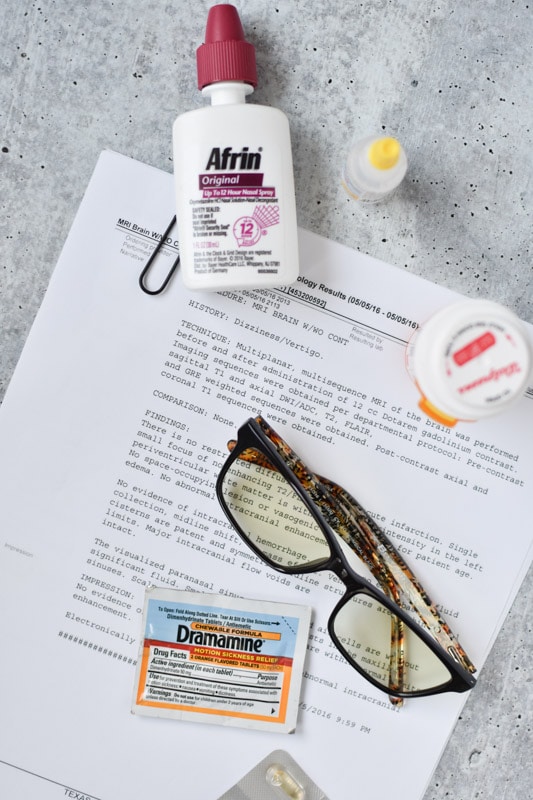
- Pack an “Emergency Kit”. When you’re in the middle of a vertigo attack, you cannot see much and the risk of falling is quite great. With an emergency kit nearby, friends or family can help get you what you may need.
I use a small makeup case and fill it with the following:
– Peppermint essential oil
– Benadryl or Dramamine
– A rescue medication (mine is Ativan)
– Mints or ginger candies
– Sea Bands or Blisslets (get 15% off with code dizzycook!)
– Ear Plugs
– Extra Magnesium, particularly magnesium lotion or a foot soak.
– Migraine relief glasses - Find something stable to sit against. What helped me was sitting against hard, flat surfaces. Whether thats a chair without a lot of padding or sitting on the floor against a wall. It gave me some stability to try to feel as grounded as possible. Sometimes having someone hold your hand can also help, just anything that brings you down to earth.
A few things you may want to avoid:
1. Comfy, overstuffed chairs or couches gave me the feeling I was falling.
2. Standing can prove to be quite dangerous. Don’t risk falling in the moment.
3. Laying flat was not helpful for me either. It increased the feelings of movement or falling. - Repeat – “You are safe. This is a temporary”. Lately I’ve been really harnessing the power of my thoughts and visualizing what I want and it’s helped immensely with keeping positive during dark moments. This mantra is part of a cognitive behavioral technique. Instead of the fear and panic that usually comes with a migrainous vertigo attack, repeating this mantra can help to calm those feelings and not exacerbate symptoms.
- Do not perform any maneuvers you see online to “help vertigo” unless instructed by your physician. These maneuvers, like the Epley maneuver are for BPPV and help move crystals from semi-circular canals of the ear. The Epley maneuver will not work for vertigo that is caused by migraine. Migrainous vertigo is coming from your central nervous system and not from the crystals in your ear.
- Find a rescue medication that works for you. For most with migraine headache attacks, this usually involves triptans, but there is limited evidence to support they work for vestibular symptoms if headache is not involved. For some, meclizine (Antivert) does resolve their attacks, which doctors may try initially. This was not the case for me, personally. Meclizine didn’t ever touch my attacks and I just had to wait it out for days. From my experience, what seems to work best as a rescue medication for these type of violent vestibular migraine attacks are benzodiazepines or alternative acute treatments.
Benzodiazepines and Dizziness
I’d love to write more about my experience with these. But for vestibular migraine, they can be highly effective acute treatments for vertigo. You physician may prescribe different types based on the length of your attacks and their coordinating life. Many are fearful of taking these vestibular suppressants, but they do not affect compensation in short term, low dose use. The lowest doses should be prescribed for vertigo attacks.
Lorazepam (Ativan), Clonazepam (Klonopin), and Diazepam are the most common prescriptions. Alprazolam (Xanax) is not recommended due to the higher rate of addiction, and how short-acting it is. Here is another study that shows benzodiazepines can be helpful for vestibular migraine.
Treatment with Antihistamines
An over the counter solution that provides people with some relief are antihistamines, like meclizine, benadryl, and dramamine. This may be the first line of attack that you and your doctor try before discussing alternatives, like benzos. Other options that may help to improve attacks are the Cefaly device, GammaCore, or extra magnesium.
For Other Posts on Vestibular Migraine:
The Vestibular Migraine Guide for Dummies
Vestibular Migraine Symptoms
Natural Treatments for VM
The Vestibular Migraine Diet
Traveling with Vestibular Migraine
Visiting Disney World with Vestibular Migraine
Vestibular Disorder Association
Research resources linked where discussed in the post.





A life changer for me was the addition of ginkgo to my daily supplements. It got rid of the the chronic vestibular symptoms and the fog. I use Valium and a relief band attacks. I am going to try your diet the recipes look good!
Hi Alicia,
Thanks so much for this informative article. I have to say that it was more useful than my recent visit with a vestibular neurologist.
Do you have any recommendations among these meds you discussed for someone with daily dizziness/vertigo symptoms? (I’ve also been on HYH diet for many months and at first it worked great but now doesn’t help as much anymore. I do use blisslets thanks to your advice which can help). I generally get this dizziness in the early afternoon and need to keep working through it or at least after it passes. Do any of these meds not make you sleepy? I would like to live a full and happy life and generally hate meds and am very sensitive to them, but this issue is so pernicious that I’m having to reconsider this stance.
Recently, someone also mentioned Zofran to me but I’m not familiar with it.
Thanks in advance for any help you can provide! This is such a terrifying and debilitating issue. Sarah
Thank you! I suppose it’s a wait it out scenario. This last episode took ten days for me to feel normal. I had a telemedicine call with Dr Cho. He’s put me on pamelor at my request. I think it’s helpful. He also wants me to have PT via zoom.
Thanks again.
I’ve was diagnosed with vestibular migraines about 3 years ago. I had a severe attack three weeks ago. I had ataxia and couldn’t get out of bed or walk without my husbands help. I had a similar attack about eight years ago. Does anyone else have ataxia? I also had BPPV during the end of the attack. Two Epley maneuvers resolved the BPPV. Is it common to have vestibular migraine and BPPV together?
Hi Judith – yes! I’m not sure about “common” but you can have both together. Ataxia is also very common with vestibular migraine.
Thank you for your generous heart in sharing your experience. I woke up with this terrible affliction on June 22, 2020. I was diagnosed with BPPV. My doctor sent me to physical therapy. They performed the Epley maneuver and the spinning stopped. I still had all of the other symptoms, dizziness, no balance, nausea, brain fog and my head feels like rubber etc. Physical therapists taught me eye exercises and I continue to improve. My confusion is with the migraine connection. I do have cervical migraines from a whiplash injury 20+ years ago. I had a migraine for 3 consecutive days prior to onset of the vertigo. Is this the probable cause of the vertigo? Keep the faith and Thanks again!
Can you put me in touch with someone who has been Effexor please. I’m think of trying this. I really did want to do meds but this isn’t getting better with just Supplements. Thank you.
TYVM! Most informative migraine article I’ve read in years.
“Headache does not occur in about 50% of all vestibular migraine attacks.”
My migraines started as vestibular (without headache), and my very first symptoms started at a fireworks show on the 4th. I went to 5-6 health care professionals before I got a diagnosis from a neurologist. Dizziness has always been my early warning sign that I’m on the edge of an active migraine phase (I’m chronic).
Bob
Thanks, Bob!!