
This post may contain affiliate links. Please see our disclosure policy.

Magnesium threonate has so many benefits, including aiding with migraine brain fog. This article will explain the benefits of magnesium threonate and how to use it to improve cognitive function.
The information presented here is purely informational and all supplement changes should be reviewed with your health practitioner before use.
Magnesium L Threonate Benefits
Magnesium has been shown to decrease migraine symptoms in general, but often we forget that different types of magnesium are helpful for different areas. Magnesium Threonate is one of the best for neurological issues, particularly because it has a high absorption rate and can penetrate the blood-brain barrier.
One particular study found it’s helpful with memory decline, Alzheimer’s disease, and enhanced learning in young rats. You’ll often see some kind of “neuro” or “cogni” in the name based on the research that supports its ability to help with cognitive and neurological functions. Magnesium L Threonate benefits include:
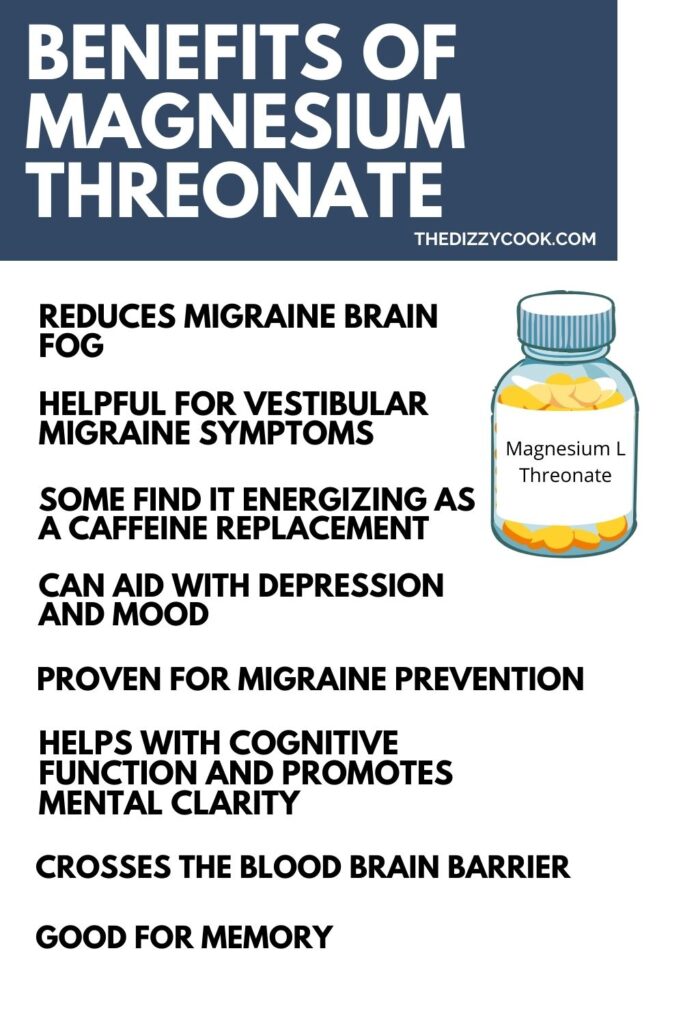
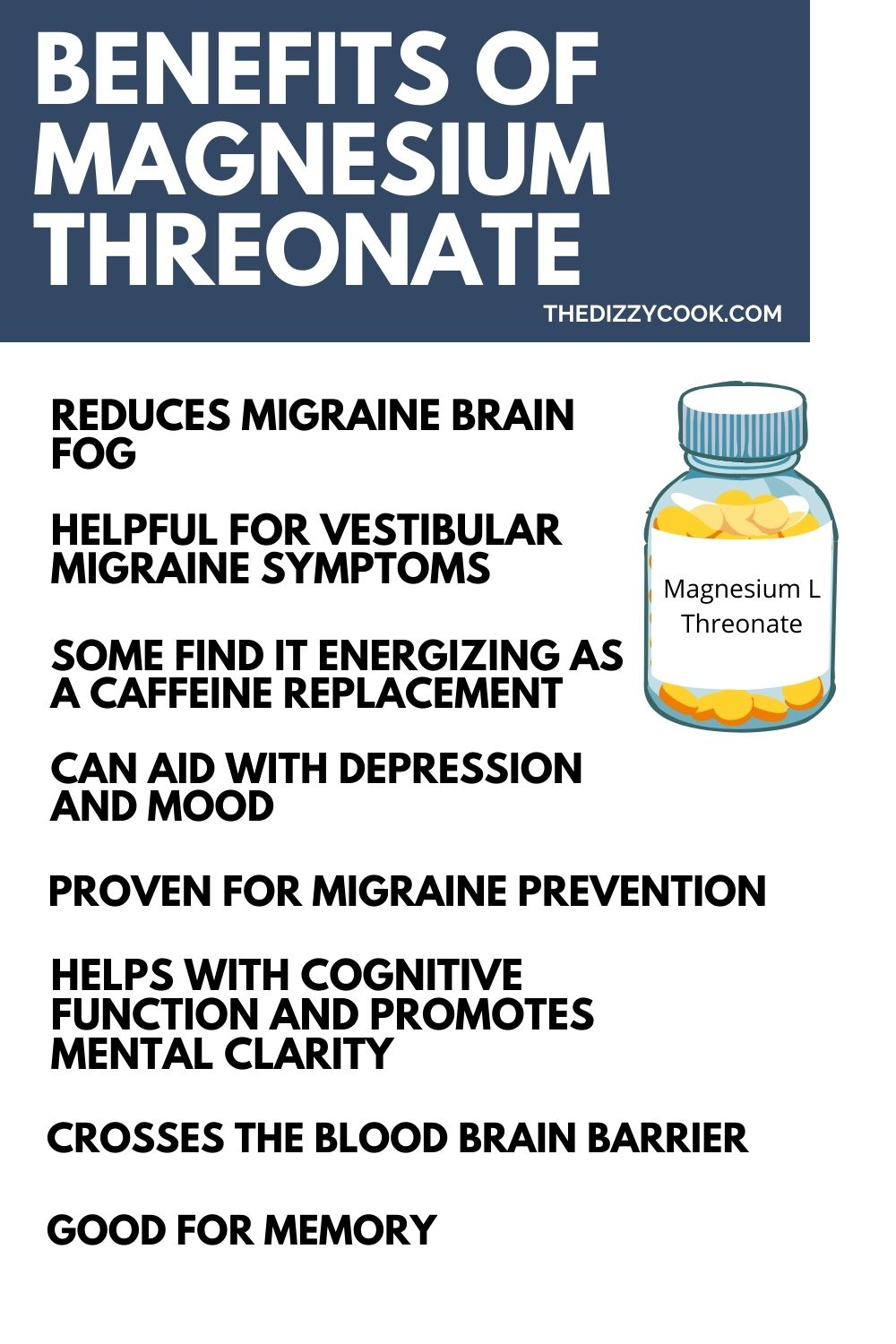
- Aids with cognitive function and promotes a “clear head”.
- Helps with migraine prevention.
- Reduces migraine brain fog common with vestibular disorders, as well as vertigo.
- Some find it energizing as a caffeine replacement.
- Can aid with depression.
- Crosses the blood brain barrier, restoring magnesium directly to the brain.
Research shows magnesium to be a critical player in the activation of nerve channels that are involved in synaptic plasticity. That means that magnesium is critical for the physiological events that are fundamental to the processes of learning, memory, cognitive function and for healthy mitochondria.
It is highly absorbable and has the unique ability to permeate the brain and enhance the receptors that are involved in this process.
Magnesium L Threonate is said to be the only form of magnesium that crosses the blood brain barrier and significantly increase the levels of magnesium within the brain – exactly where people with migraine need it!
Magnesium for Vestibular Migraine
One of the ways vestibular migraine hit me hardest was with cognitive function. Before my symptoms began I had a quick wit and often managed the work of multiple people at my job.
When my chronic illness began, I couldn’t even think of small words like “dinner” without having to pause and think incredibly hard. I’d be having a conversation and would get hung up on what I was trying to say, racking my foggy brain for basic words. Often I wonder if the anxiety I felt from this exacerbated my symptoms. I felt stupid.
There were also points where I had some short term memory loss and would misplace things regularly or forget conversations. These are all symptoms of migraine and some vestibular disorders, specifically vestibular migraine.
While this supplement is expensive, I thought I would give it a fair trial of at least a month before I refilled the supplement. I noticed fairly quickly after I would take Magnesium Threonate in the morning that I had more energy and mental clarity.
As time continued, this was a common occurrence. My morning brain fog is eliminated and I am more alert without caffeine. It is a part of my treatment plan to this day – I take two capsules of Cognimag in the morning!
Magnesium threonate can be helpful for vestibular migraine because:
- Brain fog and memory loss is common with this type of migraine.
- It can reduce dizziness and fatigue.
- It contributes to the overall amount of daily magnesium you can take for migraine prevention.
- Outside of magnesium glycinate, threonate is one of the best forms of magnesium for vestibular migraine.
Because this supplement can be expensive and the recommended dosage for migraine prevention in studies is 400mg, it is best to mix and match with another less expensive form of magnesium to get the full amount needed.
Types of Magnesium Threonate
Here are a few types of magnesium l threonate that I have personally tried.
1. CogniMag by Pure Encapsulations
CogniMag contains the patented product called Magtein, developed by researchers at MIT including a Nobel Prize winner. The total amount of magnesium is 72mg. It also includes a proprietary blend called PhytoMemory which includes blueberry and strawberry extract, as well as spinach juice.
Extremely limited on fillers, this is my personal supplement and one I recommend as the best option. 95% of my readers report some kind of success taking this daily. You can also get an exclusive discount.
2. Neuro-Mag by Life Extension
Neuromag also contains Magtein but has a few more fillers listed in ingredients (it is also less expensive. Overall you get 144mg of magnesium threonate in this supplement. If cognimag is ever on backorder, this is the one I use. This neuromag is also available at a discount.
3. NeuroMag by Designs for Health
This NeuroMag is chelated magnesium threonate and another brand I used when Cogimag was out of stock. NeuroMag has very few fillers and also contains 144mg in the daily dosage. This is not available on Amazon right now, but can be found in my supplement store. This is also generally less expensive than cognimag.
4. Less Expensive Alternatives
Several readers have emailed me to update me on their favorite brands that are a little less expensive than the ones above.
Magtein ($22)
Jarrow Magnesium Threonate ($26)
Discounted Magnesium Threonate
Magnesium L Threonate UK brands:
Dr Mercola & Life Extension

Reviews on Magnesium Threonate
“I wanted to drop you a line to say that adding magnesium threonate has been a major game changer. It clears up the heavy head feeling I have when I wake up. The change has been remarkable” – Aimee
“I started taking the Magnesium Threonate close to 2 months ago. When I had to increase my dosage of Nortriptyline to 50 mg I noticed I was fuzzy headed all the time. I added the Magnesium Threonate and I am in pretty good shape now and I have had to increase my dosage of the Nortp to 75 mg to boot. It has made a big difference. But basically after I read page on supplements I now take both Magnesium’s, B2, CoQ10 and Ginger everyday. The whole package works well…For me I have had to find alternative brands because the Pure Encap are too expensive.” – Nancy
Migraine Supplement Articles
For more articles on supplements that benefit migraine disorders, check out these posts.

Natural Treatments
The Best Magnesium Supplements for Migraine

Natural Treatments
Tryptophan for Migraine, Anxiety, and Sleep

Natural Treatments
Natural Treatments for Vestibular Migraine

Vestibular Migraine
The Vestibular Migraine Treatments That Cured My Daily Dizziness
This post was originally published August 30, 2018 and was updated December 3, 2021 with new information and an infographic.





I also recently started taking CogniMag according to the directions on the bottle (2 pills 2x a day) and seem to be doing slightly worse than when I was taking a higher dosage of magnesium (400mg 2x a day). My other magnesium pills were from Trader Joe’s and a mix of 3 oxide, citrate, & chelate. I’m not seeing any real improvement yet and wonder if I might need more magnesium overall or if it’s just the crazy weather fluctuations. Any suggestions?
Hi Christina,
I would not recommend replacing your 400mg with this magnesium alone! It’s simply an idea to supplement any magnesium you’re already taking, especially if brain fog is an issue. I take 400mg of magnesium glycinate and then just 2 pills of the CogniMag. Hopefully that will help save some money too. It could definitely be weather fluctuations as well, especially as we change seasons. I’d recommend looking into the PE Magnesium Glycinate (or the Metagenics one is good too). If you did great on the TJ’s then stick with that, but mag citrate and oxide can often cause stomach issues, oxide is generally used as a laxative. 400mg is the lowest dose you should take according to most studies, and you don’t get near that with just taking the cognimag. I hope that helps clear it up a bit.
Do you think it’s OK if I’ve tried chelated magnesium and I think I even tried another type of Glycinate (and maybe even a third haha) that I wouldn’t need to try the brand you recommended? I’m just trying not to repeat my efforts if I don’t have to and I haven’t found the difference between all the different types of magnesium I take so I just make sure I get my 500mg a day (I don’t think I notice a difference between 400 to 500 but I do 500 as it seems a lot of studies recommend that and magnesium in general seems to give me a little boost ).
It just depends. Some brands are better than others. I recommend these because they don’t have fillers or gelatin which I’ve seen be an issue for some people. When you buy a less expensive brand that has a bunch of extra items on the ingredient list, you have to wonder how good the quality of their supplements are. If it’s filled with other stuff, you may not be absorbing it well so you’re just wasting money in the long run. If you have a brand you like that works well for you, I don’t think you need to try these instead at all! Just stick with what you’re doing. 400-500mg is definitely a good place to start. At one point my neuro had me up to 700mg a day. I don’t take as much now that I’m feeling better. 🙂
I like taking CogniMag in addition to other magnesium types like chelated or glycinate for brain fog, but not as a replacement to get your 400-500mg of daily magnesium. Does that make sense? I think it’s worth it to add because it’s the only magnesium that’s been shown to cross the blood brain barrier, making it really great for neurological illnesses. Different types of magnesium are absorbed in different ways so it does make a difference which type you use.
I’ve been on it for about 12 days and haven’t noticed a difference. I’ve been taking the dose recommended on the bottle 2 pills 2 times a day which if I read the bottle correctly means I’m getting 144mg of magnesium total for the day. I normally take 500mg daily of my other magnesium pill and have tried all the other main magnesium types (including different types of glycinate) and haven’t noticed a difference between them and taking magnesium in general maybe helps a little with my fatigue. Given I’m taking the magtein, I’ve been only taking 400mg of my other magnesium though given I haven’t seen results I decided to make it 500mg and that made me a little dizzier (though who knows if it was that). Either way I’m going to stick with 400mg of my other magnesium. I have until 11/17/18 to return the magtein to amazon (hopefully they refund me if it doesn’t work) so I plan to try it til then. Do you think I should try raising or lowering the magtein dose? My neurologist didn’t recommend I bother with magtein and my pharmacist said “why not” to it and neither of them work with dizziness.
Hey Nick, While a lot of us saw a difference with the threonate in 2-3 weeks, it took me almost 4 months to notice a difference with magnesium in general when I first started. Most natural treatments do take a while to take effect and I certainly wouldn’t be discouraged after less than 2 weeks unless you really want your money back. I will say I’m not sure how much magtein helps with dizziness as when I started it I wasn’t having a lot of dizzy days. What I mainly use it for (and what I’ve heard from others that it helps with the most) is the brain fog and that slow thinking where you can’t recall words. If you haven’t noticed a difference with that, I’d say to re-evaluate after you finish the bottle to at least give it a fair shot, but I can also understand it’s very expensive. I really rely on glycinate (as it sounds like you’re doing) to help with overall dizziness and keep my VM attacks limited since it’s much less expensive. I currently only do the cognimag 1x a day in the morning, so I think with 2x a day you should be noticing a difference at some point if it’s going to work for you. Johns Hopkins recommends at least 400mg of magnesium for migraine management, so you’re really doing everything right.
I’m also wondering if you’re just relying on magnesium or if you’ve implemented any other VM treatments like medication, diet, etc? Often we need more than one thing to help us out. I will say that few of the natural treatments that my neuro (who I love and who treats mostly Vestibular Migraine) told me to not bother with, like the HYH diet, ended up working out really well for me. I think there’s still a lot to be learned about this illness, even for them. It’s really trial and error for what works best for you!
Hi Alicia. I just ordered CogniMag for my daughter. I’m wondering if you’re still as pleased with it as you were when you wrote this blog, about 2 months ago…?? Thank you for your site—such an amazing resource!!
Hi Jenny,
Yes! In fact since I wrote it I’ve had a a few people message me saying they felt a difference within 2-3 weeks (or just a few days!) as well. So far all the messages have been positive, so you’ll have to let me know how it goes for her. I’d love to do an updated page of reviews so people don’t just think this is a sales pitch. 🙂
Hi! I can’t find anywhere in my area to purchase or buy Pure Encapsulations. Do you have any advice it seems that I need to be a Dr of some sort to order. My zip code is 42104 and there’s nothing around me I’m so bummed. I have 24/7 chronic vestibular migraines and would really like to incorporate this supplement and see if it helps. Thank you.
Hi Nancy – Yes, they are only sold through medical professionals. Amazon has one on staff to accommodate this so you can order through them online here. I can give you some other websites to order from too, although amazon seems to be the favorite because of prime. I hope that helps!
Nancy, I get mine through http://www.pureformulas.com – you can even acquire points that add up to dollar amounts toward future purchases. I get free 2 day shipping with ShopRunner as well!
I’ll give it a try and let you know. I use Preventa migraine with Butterbur, magnesium, feverfew and B2. But, I’m curious if this will make a difference. I will check to see if there’s such a thing as taking too much magnesium.
There’s really not as far as magnesium! I know people who take over 1000mg a day. But your stomach will let you know if you get too much. 🙂
Hi Alicia! I am also taking Magnesium Glycinate by Pure Encapsulations. I forwarded your article to my ND and she said adding the CogniMag is a great idea! How much glycinate are you currently taking? What time of day? I’m trying to work my way up to 1200mg, but my GI is super sensitive (we’re working on fixing that as well!)
Hey Dana! I currently take 4 of the 120mg magnesium glycinate pills and 2 of the magnesium l-threonate. I split them up by taking 2 of the mag glycinate and 1 of the threonate in the morning and 1 in the evening, both with food. If I’m having a particularly bad day, I’ll add more magnesium glycinate. I used to take about 800mg a day, but this seems to help just as much as before. I will say that the addition of the l-threonate didn’t upset my stomach at all! You’ll have to let me know how it goes for you.
Two weeks into adding the threonate along with my glycinate and I cannot believe the difference in my brain fog…or should I say lack of brain fog. Even during my period I seemed to have more energy and less fog!
Dana thank you so much for letting me know! I’m so glad it’s working well for you. I’m trying to collect some more reviews on it to add. We were shocked at how quickly we noticed a difference too.
This was so helpful! I, too, struggle with daily brain fog. I will buy a bottle of this to boost my PR magnesium glycinate.
I was surprised at how quickly it worked for me since I think the glycinate took more time to notice a difference with. You’ll have to see if it’s the same for you. I’ll just keep adding reviews. 🙂
Hello, this was a great read. Recently my doctor prescribed Zoloft. Has anyone tried that in conjunction with magnesium pills?
Hey Sabrina, you may get better answers in the Migraine Strong group! But I do know a few VM members who are on zoloft and also take magnesium. Magnesium can be very helpful for both migraine and anxiety – you may enjoy this article as well.